

Academy

Advice for singing better

Short vocal technique lessons and articles by Carmen for students, choristers, conductors and professionals. To read at your own pace and try out with your voice.

“A musical hug.”Her usual sign-off

Vocal technique tips

Six situations, six solutions

Specific moments in a piece or an exercise where technique makes the difference.

01

The piece starts with the piano

Sing all the piano or orchestra phrases in your head and even breathe with them where appropriate. When your entry comes, it won’t be abrupt: it will be a continuation.

02

The phrase starts on a high note

If your mouth is closed at the start, the sound will come out tight. The mouth must give that note freedom; the rest of the phrase will follow easily. It is the same position as the EA-EA-EA exercise.

03

A demanding passage

If the interval starts on a low note, protrude the jaw with pursed lips and make the jaw turn just before the second note. With abdominal pressure, the high note will be free and never shrill.

04

Imagine the colour?

Not advisable: emotions fluctuate on stage. It is more reliable to know the right technical movement; the sound will settle on the vomer with the qualities you expect.

05

The mouth goes sideways

If the jaw shifts as you sing, only one of the two pterygoid muscles is working. Vocalise while watching the forward movement of protrusion.

06

The head tilts

That is reaching “up” for high notes. Bring your attention to the vomer, to protrusion and, above all, to the levator muscle of the upper lip.

Source: Adapted from Carmen Moreno’s “Consejos técnico-vocales” (vocal technique tips), published on the Academia page of her former website.

Podcast

Listen to Carmen

Seven episodes (in Spanish) in which she explains her vocal technique in her own voice.

Go to the podcast

Technique · octave leap

The last bar of “Signore, ascolta”

The final phrase of Liù’s aria in Puccini’s Turandot ends with an octave leap, from A3 to A4, followed by a second up to B4. Solve the octave and the second solves itself.

The strategy

The mouth prepares for the low note as if it were going to sing the high one straight away, and both are sung in that position. You don’t reach for the high note by lifting your face: every note stays in the same place, the vomer, with no more effort than necessary. The strategy works for every octave.

The execution

For the A3, the jaw protrudes forward and diagonally, and the lower lip drops to show the lower teeth. Once the note is held, the muscles joining the lower lip to the fold of the jaw move a little further forward. It is a tiny movement, with the intention of a trombone slide, and with it you sing the A4.

For the B4, the central part of the upper lip rises. The lip corners stay close and the mouth takes an oval shape. The harmonics accompany the fundamental and the high note comes out bright and intense.

The text: “Ah, pietà”

On the “p” of “pie-” the mouth position doesn’t move: just hint at bringing the central part of the lips together, without opening the corners into a smile. For the “e”, think “a”, because “e” is a closed vowel and tightens the sound on a high note. If the “t” of “tà” makes it harder, think of it as a “k” without changing the mouth. The audience will hear “Ah, pietà” perfectly.

What matters is that the sound is produced in tune and without technical difficulty for the face.

To practise: first sing the whole phrase on the vowel “a” until the jaw drop comes easily.

Mouth positioned for the low note: protruded jaw and lowered lower lip
1 · Low note, already prepared for the high one
Mouth positioned for the top note: raised upper lip and lip corners close together
2 · Maximum protrusion and raised upper lip

Source: Adapted from Carmen Moreno’s blog post “Aria: Signore ascolta. Ópera Turandot. Puccini. Cómo cantar el último compás” (in Spanish), 22 March 2015. Read the original ↗
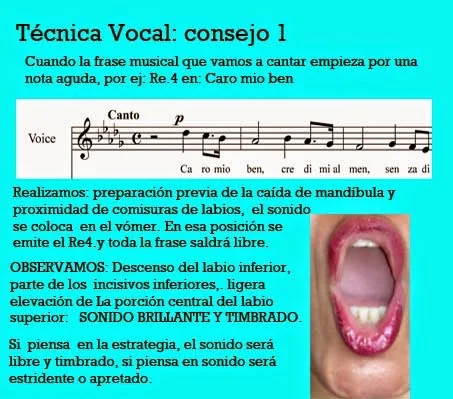

Technique · tip 1

Starting on a high note: “Caro mio ben”

When the phrase you are about to sing starts on a high note, like the D4 in “Caro mio ben”, everything depends on how your mouth is set before the first sound.

What we do

We prepare the jaw drop in advance and bring the lip corners closer. That way the sound is placed on the vomer: in that position the D4 is sung and the whole phrase comes out free.

What we observe

The lower lip drops, showing part of the lower incisors, and the central part of the upper lip lifts slightly. The result is a bright, resonant sound.

If you think about the strategy, the sound will be free and resonant; if you think about the sound, it will be shrill or tight.
Carmen’s original lesson sheet

Source: Adapted from the sheet “Técnica vocal: consejo 1” (Vocal technique: tip 1), Carmen Moreno’s teaching material.

Career · singing competitions

If you’re entering an international competition

Carmen wrote this advice for those who want to enter a competition such as the Francesc Viñas without having sung opera in theatres yet.

  • Bring your own pianist. The musical rapport you have built in rehearsal is what the jury perceives. With an unfamiliar pianist, that connection is lost.
  • Prepare your body. A movement coach will help you move with ease: a clumsy gesture can spoil a performance.
  • Stage every aria. With a theatre professional, perform as if you were inside the opera. The same goes for lieder.
  • Look after your vocal technique. It is the foundation of everything: breathing, dropping the jaw, moving the lip corners and placing the sound on the vomer.
  • Show stamina. Sing without showing fatigue, as if you could keep going: the jury is looking for someone who can sustain a whole opera.
Your door is there; you just have to know which one it is and open it.

And a reminder: a singer’s life is not reduced to one competition. If you don’t win, keep singing and training. If you win, keep studying to maintain and improve your level.

Source: Adapted from Carmen Moreno’s blog post “Festival internacional de canto, en Barcelona” (in Spanish), 24 January 2017. Read the original ↗

Repertoire · concert arias

Five Mozart concert arias for soprano

In 2012 Carmen shared on her blog a selection of Mozart concert arias, in piano reduction, for sopranos who wanted to broaden their repertoire beyond opera.

  • “Ch’io mi scordi di te?” · K. 505
  • “Misera, dove son!” · K. 369
  • “Per pietà, non ricercate” · K. 420
  • “Ma, che vi fece, o stelle” · K. 368
  • “Non più. Tutto ascoltai” · K. 490
  • “Popoli di Tessaglia!” · K. 316, in a piano reduction by John Verrall

A concert aria demands the same commitment as an opera scene, but without sets or costumes to help: all the expression rests on the voice and the text. It is good ground for applying technique to the intervals of the piece, as the method proposes.

If you’d like to work on one of them, mention it to Carmen in your lesson and she’ll prepare the most demanding passages with you.

Source: Adapted from Carmen Moreno’s blog post “Arias de Mozart para soprano” (in Spanish), 5 August 2012. Read the original ↗

Career · auditions and competitions

Losing is winning too

Alongside a list of US theatres holding auditions and international competitions for classical singers, Carmen left this reflection on her blog for those preparing to take part.

The most important thing is to enjoy the art of singing with naturalness and simplicity, to live the moment and to remember that we are only human.

Our place is not always the one we insist on being in. Sometimes, by losing, we win: we keep searching and find our true place. That is where we feel fulfilled and well, and that is what counts.

Before an audition, calmly check each call’s requirements (dates, age limit and required repertoire) and prepare that repertoire in good time, with your technique well established.

Source: Adapted from Carmen Moreno’s blog post “Audiciones en USA y concursos internacionales. Cantantes líricos” (in Spanish), 12 August 2012. Read the original ↗

Choirs · published in ArtsEduca no. 4 (2013)

Preparing my choir for a festival

Singing in a choir develops the harmonic ear: holding your own melody while hearing the others without losing pitch. For Carmen, that learning carries over into daily life as a better way of communicating with others.

The conductor’s role

Conducting is decisive. The conductor must keep their training up to date, vocalise the choir before singing, correct vocal technique (ideally first individually and then as a group) and choose pieces suited to the choir’s current level. A good selection guarantees learning, good concerts and the motivation to keep growing.

What the choir needs

  • Punctuality, responsibility and a sense of commitment.
  • A good melodic and harmonic sense.
  • Some music reading, if possible.
  • Group awareness: each section sings as if it were a single voice.
Convey to the group how important it is to enjoy what it does and offers the audience.

When the choir reaches its best level, the conductor’s challenge is to keep things simple, avoid group pride and favouritism, and support the group when a concert doesn’t go as hoped. Only then is it ready for a national or international festival.

Source: Adapted from Carmen Moreno’s blog post “Preparando mi coral para participar en un festival coral” (in Spanish), 21 December 2014. First published in ArtsEduca magazine, no. 4 (2013). Read the original ↗

Choirs · from the jury table, Kraków 2012

The key to winning a choral festival

After serving on the jury of the III International Krakow Choir Festival, Carmen summed up on her blog what separates the winning choirs from the rest. That year, she said, the musical quality of the choirs made the decision especially hard.

Good vocal technique

Every member of the choir should be trained with the same technique and vocal quality required of a soloist at a conservatoire. Technique gives security when producing the sound and, with it, quality and confidence when performing.

Vocalise before singing? Yes, of course!

The conductor’s skill

The other piece is the conductor: their ability to get the most out of the choir and, above all, to choose repertoire suited to the group’s level.

Poland also taught her a human lesson: the natural, respectful and simple treatment she received there reminded her of the humility of the people of her native Cumaná.

Source: Adapted from Carmen Moreno’s blog post “Una venezolana en Polonia” (in Spanish), 1 July 2012. Read the original ↗

Science · talk with Dr Jesús Mezones (2017)

Music: listening, feeling

“I am Music, who with sweet accents can calm every troubled heart.” — Monteverdi, L’Orfeo

What happens in the brain when we like a melody? In this shared talk, Carmen combined her perspective as a biomedical scientist and as a singer to explain it.

The pleasure we feel depends on a group of neurons called the nucleus accumbens, present in each hemisphere of the brain. When dopamine is released and its receptors are activated, we fully enjoy what we hear and feel everything from the subtlest emotions to the most electrifying.

Source: Adapted from Carmen Moreno’s blog post “Conferencia: la música, escuchar, sentir” (in Spanish), 23 January 2017. Read the original ↗

Reflections · the first text on her blog, 2007

Born with a key signature

“I’m from Cumaná, I love to sing that pure, tasty rhythm…” This is how Carmen began her blog in 2007, with a text about vocation written in the language of the score.

We all love to sing as children, but for singing or choral conducting to become a reality in adult life is another story. Like every story, it has chapters, each with its own rhythm and tempo. We must fill the spaces and lines of the stave of our life with musical training: we have to learn.

But that story also needs its key signature, and we are born with it. How do we know whether we have it? By observing ourselves honestly. When it is there, it is humble, simple and grateful: it expects neither fame nor success. It simply gathers the notes life gives it, semibreves, minims and crotchets, like a happy girl who keeps them in her notebook and turns them into her most treasured notes.

We are born with an inner key signature!

Over time the bars multiply, an inner melody begins to sound, and life, with its modulations, appoggiaturas and changes of rhythm, turns it into a symphony, a sonata, a cantata or a poem.

Source: Adapted from Carmen Moreno’s blog post “Soy soprano y de Cumaná” (in Spanish), 31 August 2007. Read the original ↗

Keep learning

From reading to your voice

Advice is easier to understand when you try it with someone watching your movements. Continue with the videos, the book or a lesson.

Your first lesson

Your voice already knows how to sing. Let’s show it how.

Tell Carmen what you want to sing and what you find difficult. She will suggest a starting point and a schedule that suits you, online or in Barcelona.

Let’s talk
Book a lesson